


The Ever-Growing Story of Tree of Life
Updated: Jun 13
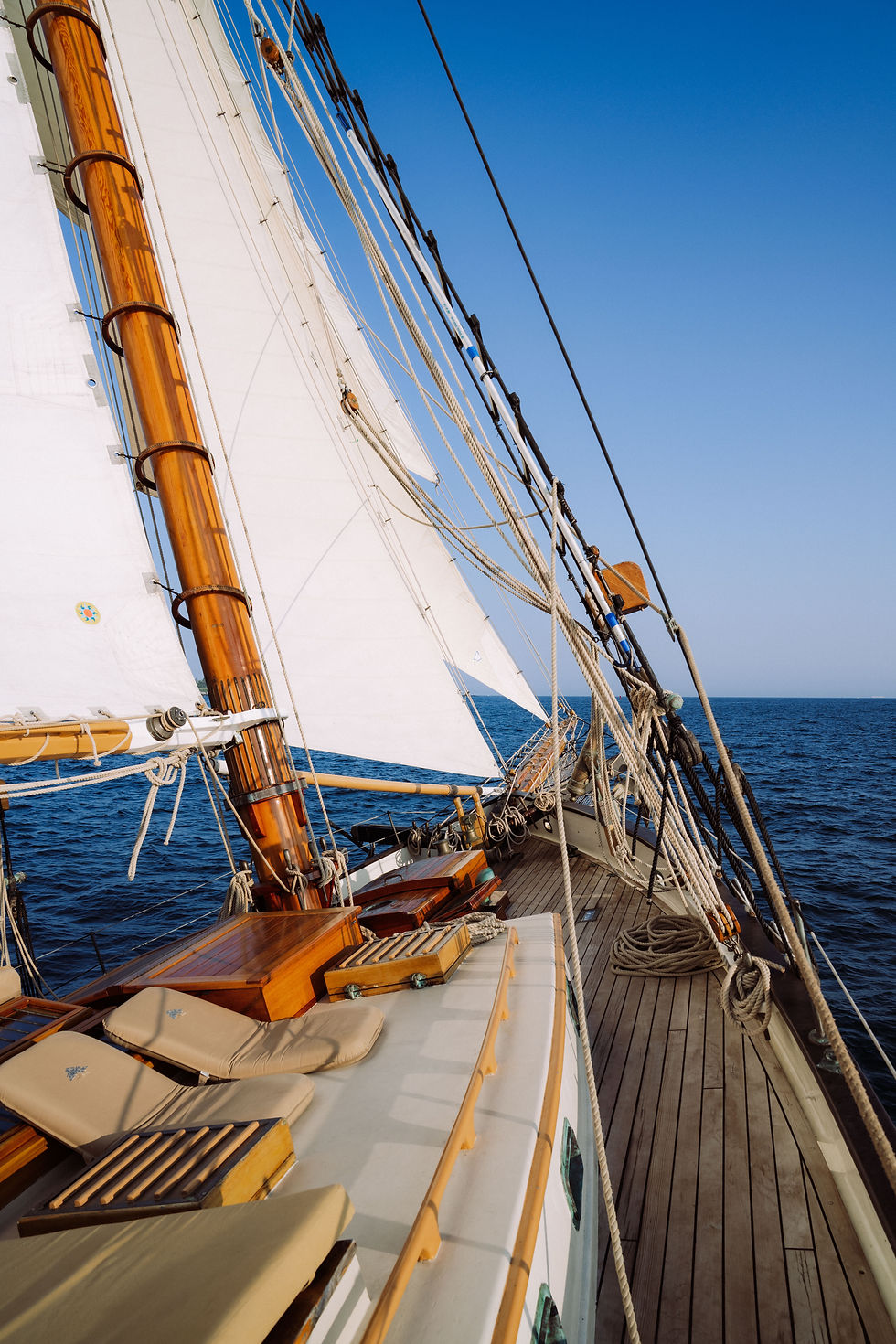
The schooner Tree of Life began as an ambitious dream: a traditional-looking vessel that could carry family and friends around the world, without the weaknesses of a conventional plank-on-frame wooden boat. That dream took shape in a Nova Scotian boat shop.
Kelly Kellogg had recently sailed from Europe and wanted a vessel capable of long ocean passages. “I always wanted to build a boat," recalls Kellogg. He had seen a schooner in Amsterdam and wanted to buy it but the owner told him it couldn't handle the ocean. Kellogg had read about Joshua Slocum's round-the-world exploits. "So, I sailed to Nova Scotia looking for a boat builder. Didn't find one."
From there Kellogg sailed to Newport for a wooden boat festival, and that's where he found Nova Scotian boat builder John Steele of Covey Island Boatworks. They clicked immediately. "I was a house builder, John was a boat builder," says Kellogg, "all we had to do was find an architect."

Steele suggested naval architect Ted Brewer, partly because a recognized designer would protect the value of such a major custom project. What followed was not a simple order for a boat, but a slow, collaborative process between owner, designer and builder. Steele remembers faxed drawings moving back and forth for roughly a year as the team solved technical questions, refined the design and balanced cost, materials and availability. “We were custom builders,” Steele says, “so we were going to build something we’d never built and the designer hadn’t designed for our methods. So it was very much a three-sided triangle.”
At Covey Island, the vessel became the largest project the yard had yet taken on by weight and volume. The hull was built of clear Douglas fir using the wood-epoxy composite construction.
To current owner Paul Morse, who bought the boat years later after owning other schooners, that construction remains one of the vessel’s defining strengths. “She’s a very traditional schooner,” Morse says, “but the modern hull construction of the Covey Island-built composite hulls, using wood, epoxy and fiberglass, means the maintenance issues and longevity issues for the hull are much, much better than a traditional wooden boat.”
A distinctive structural feature came from Kellogg’s offshore concerns. Worried about hitting a floating container or a reef at sea, he asked for extra protection forward. Covey Island double-planked the first five stations from the bow with Kevlar between the layers. Steele describes the reinforcement as a “bulletproof vest” for the forward half of the boat. Not a promise of invincibility, but it's a way to buy time and reduce damage in a collision. This feature worked when the boat bumped a reef off Thailand in later years.
The build went smoothly, for the most part. Covey Island built its hulls upside down, and rolling Tree of Life upright became a memorable event. As the heavy hull came over, it slid across the floor and struck the wall of the old general-store building that served as offices and inventory space, snapping timbers, blowing a few breakers and causing what Steele recalls as a "village brownout."
“There was a bit of excitement on that day,” he says.
The interior also reflects the depth of Kellogg’s involvement. While Covey Island built the hull, rig and some interior structure, Kellogg, a custom home builder, worked on the inside. "Down below," says current owner Morse, "is a whole host of beautiful hardwoods." Replete with mahogany, maple and teak, one of the more stunning features is panelling and doors sourced by Kellogg while he was on vacation in Hawaii.
In the Hawaiian airport, Kellogg's eye was caught by a particular kind of wood: "As soon as I saw it I said, 'I've never seen such a beautiful wood," says Kellogg, "the the grain, the pattern, the depth of colour...so I said, 'that's the kind of wood I would like to have down below.'"
Kellogg went to a lumbar yard. Climbing rickety steps, Kellogg stepped into the office, the screen door slamming behind him. There was a linoleum counter with nobody behind it, only a bell to ring. A few moments after Kellogg rang the bell, a voice from a closed room called out, "who's there? What do you want?"
"I'm looking for some koa," said Kellogg.
"Go away," said the voice dismissively, "everybody wants koa."
"It's for a boat," offered Kellogg. Silence. The door opened.
"What kind of boat?" asked the newly-visible manager. The older man had a spark of curiosity in his eyes.
"I have the plans," said Kellogg. He unrolled them on the counter and the manager came alive.
"OK, let's go out," he said, leading Kellogg into the yard.
Four hours later, Kellogg and the lumber yard manager had hand-picked pieces of wood for specific structures inside the cabin of the boat.
"Where are you going to build this boat?" asked the lumber yard manager.
"Nova Scotia," Kellogg replied.
"Nova Scotia?" said the Hawaiian lumber yard manager, "you mean Canada? They know how to build boats!"
Soon after, while the build was underway, Steele called Kellogg one morning with an important question. "Hey Kel," he said, "does this boat have a name?
Kellogg noticed music playing at the time. He asked his daughter what the song's name was, and she said, "Tree of Life."
"An electric shock went down my back, through the stool I was sitting on, through my feet into the floor," says Kellogg. "That was the most spiritual moment I've ever had in my life. And it was obvious that that was going to be the name of the boat." It was unique and traditional, like the vessel. "Who ever heard of naming a boat 'Tree of Life?'" he says. The dream schooner had a name.
Once the hull was finished and ready for launch, it was hauled with a Bell Atlantic truck before and behind it. The front truck would either lift the wires in the way of the huge vessel or cut them, and the truck in the rear would reattach them.
On the way when they saw a church by the road, Kellogg told someone to sneak inside and ring the bell as they passed, so as it approached the launch people could hear bells ringing.
After launch the hull was tied up by the LaHave bakery, and for the summer the interior and rigging were built.
A photo of the launch still hangs in the bakery.

That year Tree of Life was named "one of the 100 finest yachts in North America' by Sail magazine.
Steele can sum up his feelings for Tree of Life with one word: "Gratitude. I've had an extremely fortunate run. And I give full credit to my accountant and my marketing guy and my lead hands and my crew." Steele says he maintains a sense of rapport and friendship with former coworkers and customers even after all these years. The connection transcends generations: Steele's son skippered and his granddaughter has crewed on Tree of Life through some of its many trips.
"I was really proud of John," says Kellogg, "As the owner of Tree of Life, it was a gift to me...to create what we think is a really fabulously beautiful boat."
Current owner Morse is equally pleased with the vessel. "She's strong and resolute, but also forgiving," he says, "She's provided a lot of opportunity [for] young people that have gone on to make this a part of their life, whether it be joining the navy, working on larger boats, just working in the marine industry in general. She's been a real springboard for a lot of young people. So I would say she's kind of nurturing. That's the word I'm looking for."
"I get a lot of joy in retrospect having been a part of it, the people that were a part of it. I'm thrilled that it's still sailing, still well-maintained," says Kellogg, "the boat was a gift to me, and I was so proud to be able to do it. It was a fabulous adventure."
Tree of Life has since completed two circumnavigations and continues to work in charter service in New England. Over ten years with Kellogg she had 300 different crew, and later owners added even more numbers. This year marks 35 years since Tree of Life first hit the water in Nova Scotia.
Strong and resolute, but also forgiving. Much of that character began in her construction: a Nova Scotia-built schooner marrying traditional beauty with modern engineering.


Comments