


Thirty Years of Picton Castle: From Steam Trawler to Global Sail‑Training Barque

When Captain Daniel Moreland first found the vessel that would become Picton Castle in a Norwegian shipyard in 1991, she hardly looked destined to become one of the world's most respected sail-training ships.

Operating then as the freighter Dolmar, the riveted-steel vessel had already lived several lives: built in England in 1928 as a steam trawler, serving as a Royal Navy minesweeper during the Second World War, and later working the North Sea and Baltic trades. She looked, as Moreland puts it, "rode hard and put away wet." But beneath the weathered exterior he found a sound hull, dependable machinery and, perhaps most importantly, "a happy ship."
Moreland had spent years searching for the right vessel, looking at more than 40 candidates before choosing her. His vision was always to transform the ship into a traditional square-rigged sail-training vessel, and he always knew where that transformation would happen.

"If ever I put my own ship together," he recalls, "I will do it there in Lunenburg."
After an eventful Atlantic crossing from Norway, Picton Castle arrived in Lunenburg in 1995. The refit quickly became a community effort involving the Lunenburg Foundry, Snyder's Shipbuilding, Scotia Trawlers, local welders, machinists, sailmakers and dozens of marine tradespeople.
"It takes an entire community," said former crew member, voyage coordinator and Chief Operations Officer Maggie Ostler. Over nearly two decades with the ship, she watched countless Nova Scotia craftspeople maintain everything from steelwork and carpentry to electronics and rigging. "That's one of the special and unique things about being in Lunenburg. Those skills exist here."

The ship was always intended as a floating classroom. Since beginning her first circumnavigation in 1997, Picton Castle has carried trainees from around the world on multi-month voyages, teaching traditional seamanship through hands-on experience. Ostler was one of them.
Growing up in suburban Ontario, she had never seen the ocean before applying to join the ship after watching the television series Tall Ship Chronicles. She arrived in Lunenburg with no sailing experience, worried she might not contribute anything useful. Instead, the voyage changed her life.

"It really gave me a whole world," she said. The whole boat was fascinating, especially the masts and rigging. Maggie started out knowing nothing and soon knew the vessel inside and out, including all the ropes of the rigging: "I knew all my lines. There are over 200 of them that come down to the deck on the Picton Castle," she explains, "and I knew them all and could find them."
Maggie enjoyed becoming familiar with a ship she describes as "steady and solid and reliable and dependable...she's a happy ship. She attracts good people."

Beyond learning technical skills, she discovered the power of teamwork and living in a close-knit crew where everyone depends on one another. "The absolute best part of sailing is being part of a crew," she says, "being part of that community on board."
By the end of her circumnavigation, she was teaching newer trainees herself. She became the ship's purser, managing money. After two and a half years on board moved to an on-shore role where she spent almost 18 years managing operations and coordinating voyages.
She says one transformation never stopped amazing her. "Seeing people at the start of a voyage, maybe a bit timid... and then seeing them at the end," she says. "The personal confidence and the level of pride in what they do...it's incredible, and it's universal."
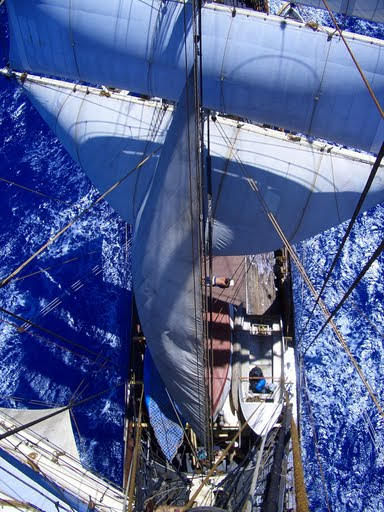
The Picton Castle remains one of Lunenburg's most well-travelled and recognizable ambassadors, carrying trainees across the world's oceans while continuing to rely on the expertise of the town's working waterfront.
Thirty years after arriving in Nova Scotia, the ship continues to prove that Lunenburg and Nova Scotia are the best place to find marine training, skill, and life-changing ocean adventure.


Comments