


Quiet Queen of Halifax Harbour: The Electric Violet Mac
Updated: Feb 9

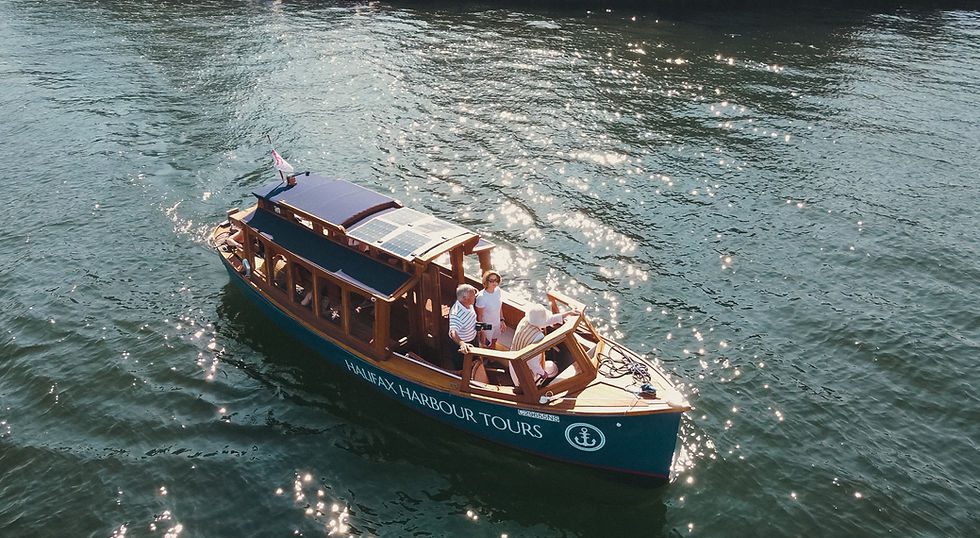
Autumn sun glints off the shifting waters of Halifax Harbour. A Dartmouth ferry trundles by. The Violet Mac putters across the one of the deepest harbours in the world, afternoon light shining through its windows as passengers marvel at the sight of a container ship parked down the wharves from a Navy ship, all under the two bridges, with little George's Island sitting in the middle of it all.
The Violet Mac is almost soundless because it is powered by electricity. That's how Colin Smith, owner of Halifax Harbour Tours, wanted it. Built by Boudreau’s Boat Building in Tusket, Nova Scotia, this electric vessel blends maritime history with modern, forward-thinking technology, and has become one quiet step into modern boating.
At the heart of the Violet Mac is an electric propulsion system designed for reliability and efficiency rather than speed. The boat runs on a 48-volt system with an 8 kW LMV motor powered by two series 3500 Torqeedo batteries. According to Smith, the trick of electric propulsion isn’t fancy hardware—it’s dry, tight connections and careful heat management. Attention to detail has paid off: after seven years of use, the batteries still retain 94 percent of their capacity.
From the builder’s perspective, the electric system wasn’t a radical departure so much as a careful adaptation. “It was basically no different than a diesel engine showing up to my shop,” says Jeramy Boudreau, owner of Boudreau’s Boat Building. “He dropped off a bunch of boxes of parts and components, and we rebuilt the engine beds, realigned the shaft, and readjusted everything.” The motor uses the same shaft and propeller size as the previous diesel setup, without the noise, vibration, or fumes.

The system is economical for Halifax Harbour Tours. On an average 10-hour operating day, the Violet Mac uses only about half of its battery capacity. With a 7 kW system drawing roughly 3.5 kW in typical operation, the cost works out to just cents per hour at Nova Scotia Power rates. There’s no fuel to haul, no tanks to refill, and no exhaust drifting across the water—just quiet propulsion turning an 18-inch propeller at 1,000-1,200 RPM, moving the boat along at about three knots. And for safety's sake, the marine-grade batteries are designed to shut down automatically if they overheat, get too cold, or experience a significant shock.
One of the most striking differences is the quiet. Unlike diesel installations that require sound- and vibration-dampening, the electric motor needs little more than standard engine mounts and custom-built vents. “It’s pretty quiet,” Boudreau says.
Quiet is good for a small tour boat where conversation, narration, and passenger interaction are central to the experience, so electric propulsion makes perfect sense.
The hull began life as a flat-decked cargo-carrying steamboat on the River Thames, roughly the same size as the vessel made famous in the 1951 movie The African Queen, though with a round stern. In the late 1960s, its rotting wooden hull was used as a mould to create a fiberglass replacement, and its steam engines were discarded in favour of a 40-horsepower diesel. Reborn as a tour boat in Puerto Rico, then later known as the Everglades Queen in Florida, it spent decades carrying passengers before being sidelined by faster, flashier boats. After a final chapter on Lake Erie, it was retired to a barn west of Cleveland.
Smith discovered the boat in 2015 and knew he had the bones of the boat he wanted. When he brought the boat to Tusket, Boudreau recalls, “There was nothing but a hull.” Over three to four months, the vessel underwent a near-total rebuild. New steel floor frames were installed, fiberglass work was completed, and the structure was reconfigured to account for the different weight distribution and stability requirements of electric propulsion. “The hull was designed originally for diesel,” Boudreau explains, “so we had to change a lot to make sure it had the stability it needed heading back to Halifax.”

Smith calls the Violet Mac his “Disney boat”—designed to look good from a distance, serviceable, and sturdy enough for daily use. Douglas fir salvaged from various sources forms the cabin, built from a single photograph of an old Thames passenger boat. Vintage details can be found throughout: brass and bronze fittings from the original vessel, a steering wheel from a 1929 Dodge, a horn from a 1919 Model T, and a dashboard modelled after a 1969 Jaguar E-Type. Smith built the wheelhouse himself.

These days, after seven years of touring, the Violet Mac leaves the same dock every morning and returns every night with power to spare. And there may be a new vessel added to the fleet soon, that will share the Harbour with the Violet Mac. The passengers and crew will have lots to talk about, and they will hear every word.


Comments